The Stewardship Triad
A Discerning Method for Evaluating AI Adoption in Clinical and Pastoral Care
Free to use in teaching, supervision, and team decisions. Licensed CC BY-NC 4.0.
Cite as: Hoppe, K. B. (2026). The Stewardship Triad: A discerning method for evaluating AI adoption in clinical and pastoral care. Zenodo. doi.org/10.5281/zenodo.2280303
Find the Stewardship Triad
By Kathy B. Hoppe (also known as Hoppe, K. J.)
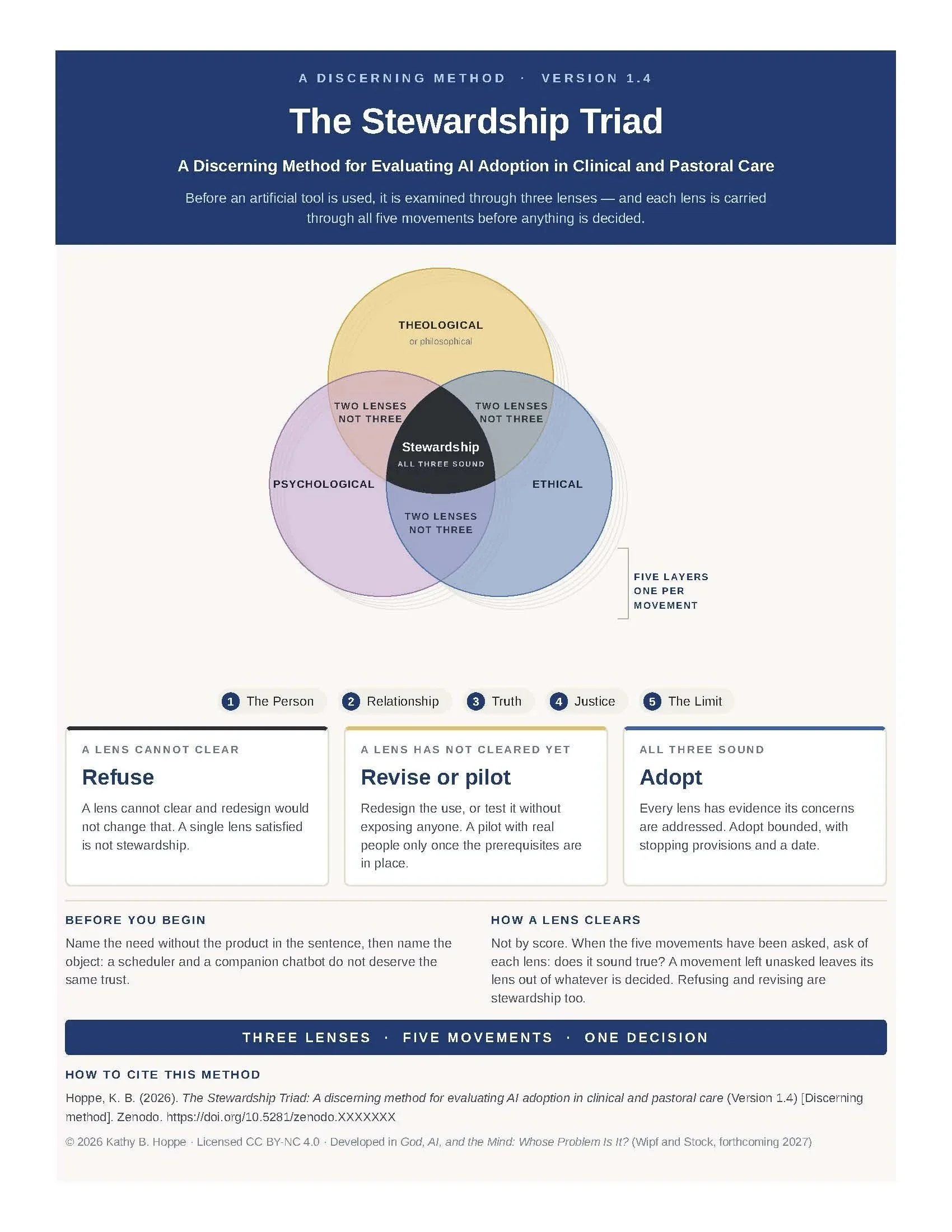
The Stewardship Triad addresses the systemic gaps in AI adoption within care environments by examining tools through three simultaneous lenses: Theological/Philosophical, Psychological, and Ethical. Designed for counselors, chaplains, and administrators, the framework uses five operational movements (The Person, Relationship, Truth, Justice, and Limit) across these lenses to produce fifteen core evaluation questions.
This leads to definitive outcomes: Stop (halting adoption if any lens fails), Revised/Bounded Pilot (restricting use with named limits), Refuse (deny the tool), or Adopted Bounded (full adoption with strict review dates). It also requires establishing a strict Human Intervention Threshold with a designated authority to override or halt the system.
The framework is available under a Creative Commons CC BY-NC 4.0 license, and the full instruments and academic citation are in the referenced web document.
Who Is It For?
Counselors, therapists, social workers, chaplains, ministers, clinical supervisors, and the administrators who sign the contracts. It assumes no technical training.
The Stewardship Triad is a discerning method for deciding whether and how an artificial intelligence tool should be used in clinical or pastoral care.